


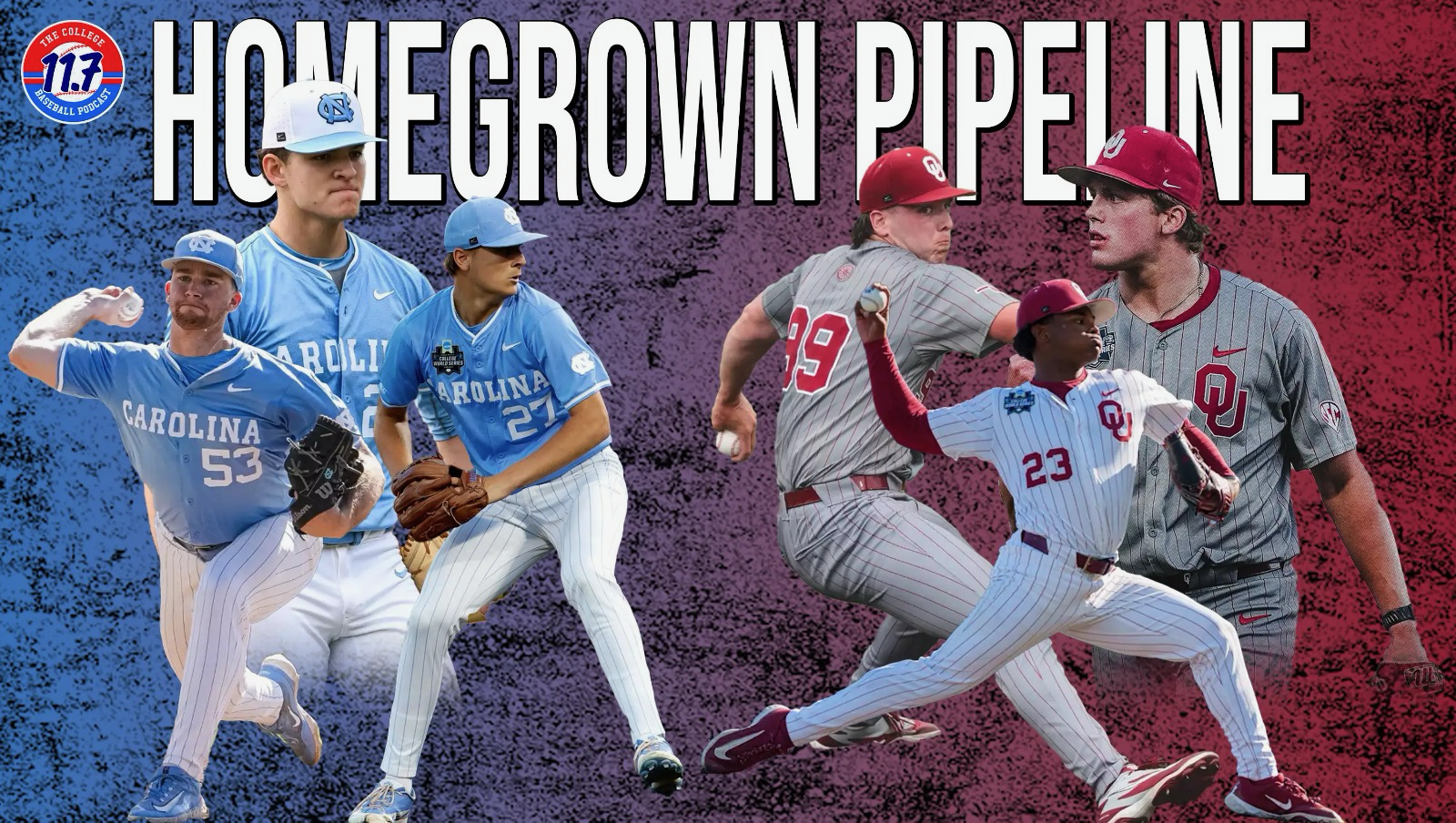
This weekend the College World Series Finals will feature No. 5 North Carolina vs Oklahoma. The Sooners are your classic case of a team getting scorching hot, peaking at the right time, and playing their best baseball in the NCAA Tournament. North Carolina has been a top 5 team for the majority of the season. Both teams took incredibly different paths throughout the season to get to where they are. With that said, UNC and OU have some similarities between each other and recent teams to play in the National Championship series.
An avid college baseball fan would tell you that the 2026 College World Series has been really offensive. They would not be wrong.
In 12 games, teams are hitting .255, have scored 135 runs (11.25 RPG), and are hitting for more power in Charles Schwab Field than ever. However, that’s still below the .277 batting average and 13.2 runs per game across all Division I games this season per CBI.
Good starting pitching has dictated gamescripts early and often in this year’s College World Series. In the 2026 CWS there have only been four true lead changes.
Game 1 (West Virginia vs Troy) featured two lead changes, Game 2 (UNC vs Ole Miss) had one, and the last lead change happened in Game 5 (UM vs Troy). All nine of the other CWS games did not feature a lead change. This season in Omaha, the team that scores the first run of the game has a record of 10-2.
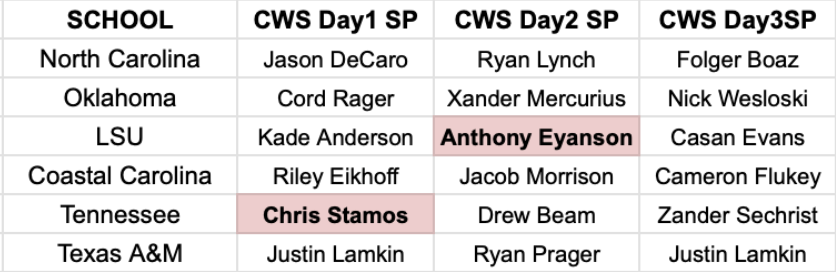
There is one thing that all of North Carolina’s and Oklahoma’s starting pitchers have in common. Jason DeCaro, Ryan Lynch, Folger Boaz, Cord Rager, Xander Mercurius, and Nick Wesloski were all recruited to their respective programs out of high school.
“We have put emphasis on high school pitching,” stated North Carolina Coach Scott Forbes. “I’ve always believed with my pitching background that if you’re 17 or 18 years old, and you got command, and – 90-92 with three pitches, that usually doesn’t go backwards.”
In fact, out of the last six teams to play in the CWS Finals (UNC, OU, LSU, Coastal Carolina, Tennessee, and Texas A&M), 15 of the 17 (88%) starting pitchers used to begin their first three gamedays in Omaha were recruited to their institutions out of H.S.
Naturally, in the game of baseball, the pitcher has more control over how a gamescript goes. If an average arm has his A+ stuff, he can shut down an elite lineup on any given day. Vice versa is a much more rare occasion.
“The harder part offensively is the physicality of swinging the bat and being able to handle playing every day as a position player and so many at bats. So, I think you’re more at an advantage if you’re an older player positionally than you are as a pitcher.”
Experience typically wins out in college baseball. The Sooners will try to buck that trend with their trio of freshman starting pitchers. UNC Coach Forbes also touched on maintaining the delicate balance of recruiting high school talent while maintaining a veteran presence:
“We still want to get the best high school players in our state, and we want to get the best high school players in the country. However, you have to mix that in with the transfer portal and be realistic that it’s harder to win with really young players everywhere.”
Excluding Oklahoma’s three starting pitchers in this year’s CWS Finals, just one of the other 14 CWS SPs over the last three seasons was a freshman. That was Casan Evans from LSU, and he’s only in here because of a technicality. Evans started the resumed game against UCLA during the 2025 CWS. If that UCLA game didn’t get delayed by weather, Evans would most likely have been the Tigers’ starting pitcher in their third game against Arkansas.
Coach Forbes finished his statement about the 2026 MCWS Finals starting pitchers with, “It’s good recruiting by both sides and I think that’s why we’re both in the finals.”

This weekend the College World Series Finals will feature No. 5 North Carolina vs Oklahoma. The Sooners are your classic case of a team getting scorching hot, peaking at the right time, and playing their best baseball in the NCAA Tournament. North Carolina has been a top 5 team for the majority of the season. Both teams took incredibly different paths throughout the season to get to where they are. With that said, UNC and OU have some similarities between each other and recent teams to play in the National Championship series.
An avid college baseball fan would tell you that the 2026 College World Series has been really offensive. They would not be wrong.
In 12 games, teams are hitting .255, have scored 135 runs (11.25 RPG), and are hitting for more power in Charles Schwab Field than ever. However, that’s still below the .277 batting average and 13.2 runs per game across all Division I games this season per CBI.
Good starting pitching has dictated gamescripts early and often in this year’s College World Series. In the 2026 CWS there have only been four true lead changes.
Game 1 (West Virginia vs Troy) featured two lead changes, Game 2 (UNC vs Ole Miss) had one, and the last lead change happened in Game 5 (UM vs Troy). All nine of the other CWS games did not feature a lead change. This season in Omaha, the team that scores the first run of the game has a record of 10-2.
There is one thing that all of North Carolina’s and Oklahoma’s starting pitchers have in common. Jason DeCaro, Ryan Lynch, Folger Boaz, Cord Rager, Xander Mercurius, and Nick Wesloski were all recruited to their respective programs out of high school.
“We have put emphasis on high school pitching,” stated North Carolina Coach Scott Forbes. “I’ve always believed with my pitching background that if you’re 17 or 18 years old, and you got command, and – 90-92 with three pitches, that usually doesn’t go backwards.”
In fact, out of the last six teams to play in the CWS Finals (UNC, OU, LSU, Coastal Carolina, Tennessee, and Texas A&M), 15 of the 17 (88%) starting pitchers used to begin their first three gamedays in Omaha were recruited to their institutions out of H.S.
Naturally, in the game of baseball, the pitcher has more control over how a gamescript goes. If an average arm has his A+ stuff, he can shut down an elite lineup on any given day. Vice versa is a much more rare occasion.
“The harder part offensively is the physicality of swinging the bat and being able to handle playing every day as a position player and so many at bats. So, I think you’re more at an advantage if you’re an older player positionally than you are as a pitcher.”
Experience typically wins out in college baseball. The Sooners will try to buck that trend with their trio of freshman starting pitchers. UNC Coach Forbes also touched on maintaining the delicate balance of recruiting high school talent while maintaining a veteran presence:
“We still want to get the best high school players in our state, and we want to get the best high school players in the country. However, you have to mix that in with the transfer portal and be realistic that it’s harder to win with really young players everywhere.”
Excluding Oklahoma’s three starting pitchers in this year’s CWS Finals, just one of the other 14 CWS SPs over the last three seasons was a freshman. That was Casan Evans from LSU, and he’s only in here because of a technicality. Evans started the resumed game against UCLA during the 2025 CWS. If that UCLA game didn’t get delayed by weather, Evans would most likely have been the Tigers’ starting pitcher in their third game against Arkansas.
Coach Forbes finished his statement about the 2026 MCWS Finals starting pitchers with, “It’s good recruiting by both sides and I think that’s why we’re both in the finals.”


